Building a Nation's Economic Backbone — Marampa, Sierra Leone | Graeme Hossie & London Mining
$500M annual export revenue. $1bn of investment. 50,000 people lifted from poverty. A mine dormant for 40 years — rebuilt from absolute beginnings.
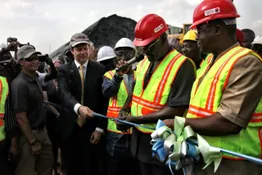
The Starting Point
The Marampa iron ore deposit in Sierra Leone had not been mined industrially for over forty years when London Mining first investigated it in 2006. The country had emerged from a civil war less than five years earlier. There was no operating infrastructure, no trained mining workforce, no logistics chain, and no established template for large-scale foreign private investment in the country. What there was: an historical iron ore deposit, a government willing to support responsible development, and a tightening global market for high-grade iron ore concentrate.
The Development Pathway
London Mining began with an exploration licence and a small London-based management team. Over eight years, the following was built from first principles:
- A president, cabinet and parliamentary-approved mining development and stabilisation agreement with the Sierra Leone government
- A thousands-strong trained operational mining and industrial workforce — from exploration encampments through to full-scale production
- First exports in 40 years, reestablishing regional economic growth and, according to UN consultants, lifting 50,000 people out of poverty
- A world-class mine and beneficiation plant, growing from 1.8mtpa initial capacity to a 5mtpa run rate
- A tenfold resource increase from under 100mt to over 1,000mt of measured and indicated resources
- A fully integrated 100+ kilometre bulk export logistics chain
- Offtake and working capital financing arrangements with Glencore, Vitol, and Cargill
- A $500 million annual export revenue operation, representing approximately 10% of Sierra Leone's GDP
The Stakeholder Dimension
The Marampa project required simultaneous navigation of tribal, local, regional, national, and international stakeholders. Village relocations along logistics infrastructure routes were later used as government best-practice examples. Community development programmes were built in partnership with DFID, GIZ, and international NGOs covering agriculture, education, training and economic diversification. A voluntary tenfold increase by London Mining of community development royalty from statutory rates led to a resetting of subsequent mining law as the standard.
The Harvard / Ivey Case Study
The complexity of the Sierra Leone development — particularly the stakeholder navigation, government negotiations, and approach to overcoming existential operational challenges — was used as the subject of an Ivey Business School and Harvard Business School teaching case, 'Doing Business in Sierra Leone,' used in MBA and executive education programmes.
What Endures
When London Mining entered administration in 2014, due to iron ore market crash, Ebola shutdowns and withdrawal of finance from the sector, the Sierra Leone asset was sold as part of the restructuring. The mine — Marampa — continues to operate today, employing thousands of Sierra Leoneans and contributing to the country's economic development. The infrastructure and industrial plants, the workforce, and the systems that London Mining built are the foundation it still operates on.